

Provocation is a strategy.
Why controversy is one of the most powerful tools in marketing, and why it only works when there is substance behind it.

Emma Grede launched her book “Start With Yourself” on April 14th and immediately set the internet on fire. A three-hour mom. Work from home is career suicide. Stop asking about work-life balance and start talking about power. The soundbites landed like grenades in a comment section, and within days, every marketing podcast, LinkedIn feed, and group chat I follow was discussing whether Grede was a visionary, a provocateur, or simply a very wealthy woman handing out advice that only works if you already have a nanny and a private driver.
What almost nobody was talking about was how deliberate it all was.
When Fortune asked Grede about the backlash building around her book tour, she said something that stopped me: “I’d be more worried if nobody was talking.” That is not the response of someone who accidentally sparked a controversy. That is the response of someone who understood exactly what they were doing from the moment they wrote the first chapter.

Provocation as a strategy
We live in the most crowded attention economy in history. Every brand, every public figure, every book, every campaign is competing for the same finite resource: the willingness of a human being to stop scrolling for a few seconds and engage. Most of the strategies deployed to win that attention, polished production, celebrity endorsements, carefully optimised captions, are so widely used that they have become invisible. The brain filters them out before they even register.
Provocation cuts through differently. A genuinely provocative statement or campaign does something that no amount of production budget can buy: it creates an involuntary reaction. You cannot scroll past it neutrally.
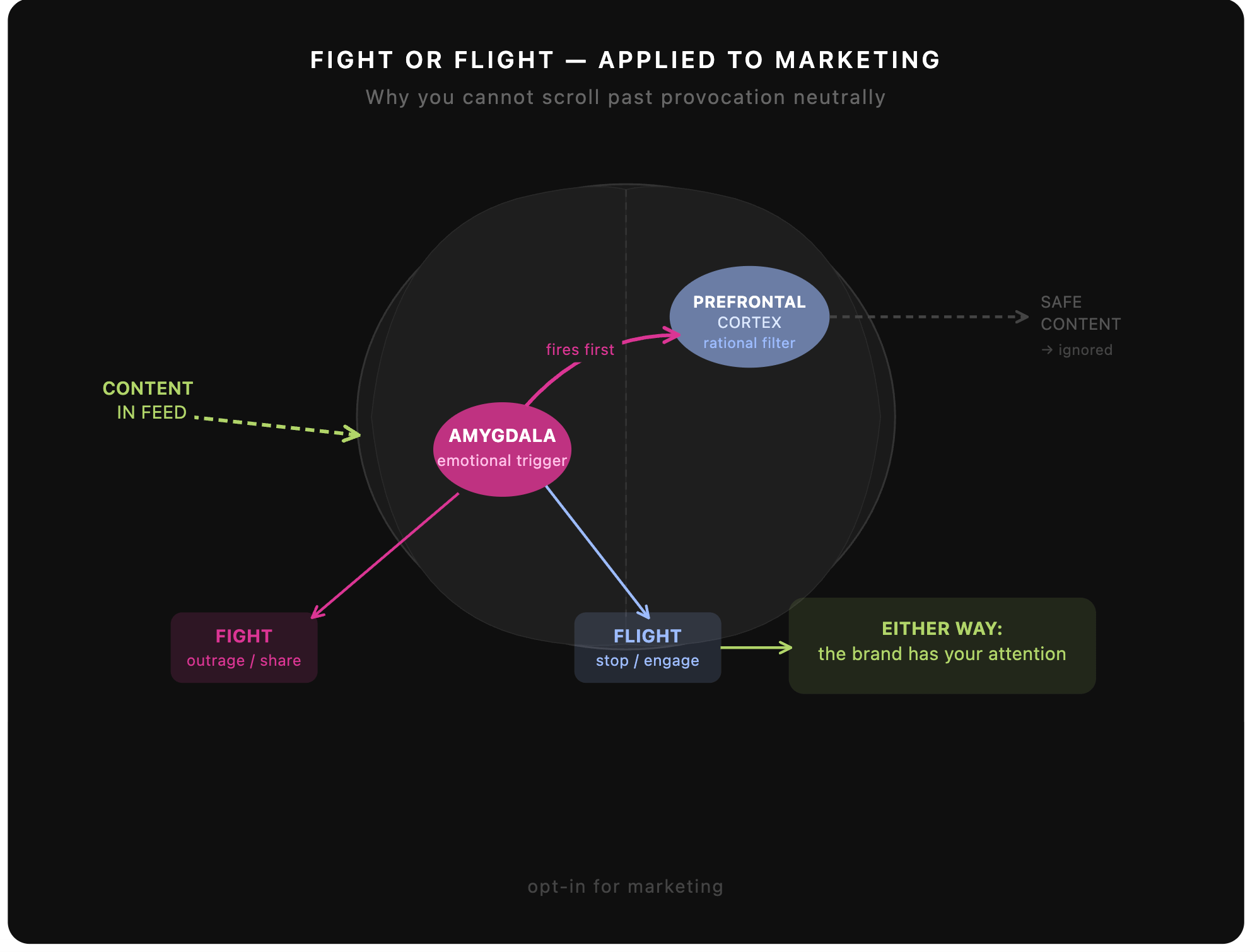
You have to respond, even if only internally. And in that moment of reaction, a connection is made between the audience and the brand or person doing the provoking. They have your attention. And attention, once captured, is the foundation of everything else.
The goal of provocation is not to make everyone agree with you. It is to make it impossible for anyone to ignore you.
When provocation works financially and fails culturally
Last summer, American Eagle launched a campaign featuring Sydney Sweeney called “Sydney Sweeney Has Great Jeans.” The central idea was a pun: Sweeney talking about genes, the biological kind, while wearing their jeans. On paper it is a harmless wordplay campaign. In practice it detonated across social media for weeks.

Critics argued the ad carried eugenicist undertones: a white, blonde, blue-eyed woman talking about superior genetic inheritance while selling clothing. The brand insisted it was a lighthearted pun. The internet was not convinced. The debate pulled in politicians, cultural commentators, and eventually President Trump, who posted his support for Sweeney on Truth Social. The campaign became one of the most talked-about pieces of advertising in 2025.
And then American Eagle reported the results. The campaign generated 40 billion impressions. Stock jumped nearly 25% after earnings. The CMO called Sweeney “a winner” and credited the campaign with unprecedented new customer acquisition.
So was it a success? By the numbers, unambiguously yes. By the standards of intentional, meaningful provocation, that is a more complicated question.
The problem with the American Eagle campaign is that the controversy was not fully in their control. The brand did not set out to spark a debate about eugenics. They set out to make a cheeky wordplay ad. The firestorm that followed was partly accidental, partly amplified by a political moment that had nothing to do with their jeans, and partly managed well enough to convert attention into sales. They got lucky with the outcome. That is different from having a strategy.
The proof is in what they did next. American Eagle’s 2026 follow-up campaign with Sweeney, called “Syd for Short,” deliberately stripped out any reference to genes or genetics. Subdued, beachy, safe. The brand that accidentally became the most talked-about advertiser of the summer quietly stepped back from the edge the moment they had the choice. That is not the behaviour of a brand that understands provocation as a strategy. That is the behaviour of a brand that stumbled into a fire, warmed their hands on it, and then backed away before they got burned.
When provocation has a point
Emma Grede’s approach is structurally different, and it is worth understanding why.
Her most controversial statements, the three-hour mom, the anti-remote work position, the insistence that women need to stop soft-pedalling their ambition, are not random provocations designed to generate noise. They are the direct, uncompromising expression of a specific and coherent worldview. You can disagree with that worldview. Many people do, and many of the critiques around privilege and structural inequality are entirely valid. But the provocations are not detached from the substance. They are the substance.
When Grede says she is a three-hour mom, she is not trying to shock you. She is making a point about the performance of motherhood, about the guilt industrial complex that tells women they are failing unless they are optimally present at all times, and about the way that guilt functions as a mechanism of control. You can argue with the conclusion. But there is an argument there. The provocation is a vehicle for an idea, not a substitute for one.
That distinction is everything. The most effective provocation in marketing is not the loudest or the most controversial. It is the provocation that has a defensible position underneath it. Something the brand or person actually believes, is prepared to stand behind, and is willing to keep standing behind when the pushback comes. Grede said she would be more worried if nobody was talking. That is confidence in the substance, not just in the strategy.
The line between provocation and rage bait
Rage bait, which is what most brands attempting provocation actually produce, is provocation without substance. It is engineered outrage designed to generate impressions with no particular idea behind it. It works in the short term, the same way junk food works: it produces a spike and then leaves you with nothing. The audience that comes to you through pure outrage is not an audience that trusts you. They came for the spectacle. They will leave when the spectacle is over.
Provocation with substance does something different. It attracts the people who agree with you and repels the people who do not, which is actually a feature rather than a bug. A brand or a public figure who stands for something specific will always have detractors. But they will also have advocates, people who feel genuinely seen by the position being taken, who share it not because it is entertaining but because it expresses something they believe and have not heard said plainly before.
That is the audience worth building. Not the largest possible audience, but the audience that actually cares. Grede is not trying to convince her critics. She is speaking to the women who already feel what she is describing and needed someone to say it without apologising. The controversy is the signal that she found them.
As always, thanks for reading opt-in for marketing.
Talk to you soon,
Oumaima